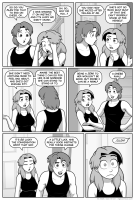
Trap Sprung
Mar. 19th, 2026 10:01 pm
psst if you sign up for the $5/month tier on my patreon you can see the (very nsfw) thirst pic

psst if you sign up for the $5/month tier on my patreon you can see the (very nsfw) thirst pic
Read Social Insecurity, Part 11

Caller: *Freaks out.* "I'm not telling you my social out loud! I'm in a busy coffee shop!"
Me: "Perhaps you can call later when you're in a safer place to discuss your personal finances."
![]()
One day, our Training Director left for a meeting. As he reversed out from under the building, I glanced out and was shocked to see his briefcase on the roof of his car, then watched helplessly (there were no mobile phones back then, either) as he drove away.

Customer: *Yanking on the door handle, shouting through the glass.* "Hey! The door is stuck!"
Me: "It's not stuck, it's locked! We're closed on holidays!"
Customer: "C'mon, just sell me some beers!"
Read Take Away 12% And I Am 100% Out Of Here
![]()
Me: *Barely polite now.* "Excuse me, but I’m not misinformed. If you want me to sign that contract, it has to be changed first."
Lady: *Now getting annoyed.* "I don’t understand why you argue! Just sign!"
![]()
Me: "Sorry, ma'am, that's the wrong card. I need to see your Sam's Club membership card."
Customer: *Gesturing to her Target credit card.* "Are you blind? This proves I'm a member."

Like two peas in a time travel pod, archivist and author Katy Rawdon teamed up with Hugo-award winning editor Lynne M. Thomas to craft the perfect time travel narrative. Take a closer look at famous time travel stories from all across the globe in The Infinite Loop: Archives and Time Travel in the Popular Imagination, with a foreword from one such writer herself, Connie Willis.
KATY RAWDON (a.k.a. KATY JAMES):
Archives are made of time. Time is made of archives. Archives are where time gets mixed up, turned around, and pulled apart.
I have always been obsessed with time, frustrated with it, wanting to tear at it and see what’s behind and underneath it. No doubt that’s why I became an archivist some thirty years ago, so that I could look at the physical remnants of time and preserve them, see what’s missing, and organize and interpret time’s leftovers for people who, wisely, do not think about time all the… time.
When I was approached to submit an idea (a big idea!) for a book series jointly published by the American Library Association (ALA) and the Society of American Archivists (SAA) called Archival Futures – a series that tackles big ideas around the archival profession – there was only one possible topic for me to write about: time.
While the phrase “archives are like time travel” is thrown around a lot, I knew the relationship between historical records and time was far more complicated. Archives reinforce and challenge our very conceptions of time, of what has happened, of what will happen, of what is truth and what is unknowable. The evidence of archives can be used to demonstrate how the past is so much more faceted than the narrow stories of history we tend to tell ourselves and others. Archives can also be selectively wielded as propaganda, or erased to allow for falsehoods to sprout and flourish in the empty spaces. Time can be illustrated, illuminated, rendered invisible, or constructed in new ways using the material items created in the course of history.
Unfortunately, all of this turned out to be so complicated that the series’ word limit of 50,000 was never going to cover it, as I painfully discovered while writing the book proposal.
I am forever grateful that the inimitable Lynne M. Thomas stepped into my creative mess and provided direction: Why not analyze the depiction of both archives and time travel in popular narratives (books, television, movies, etc.) and see what we could unearth? As a romance author (Katy James) as well as an archivist (Katy Rawdon), I was more than happy to spend time in fictional worlds in order to better understand my non-fictional archivist profession.
It turns out that we unearthed a lot – about cultural views regarding time and time travel, the popular perception of archives and archivists, and the ways current archival theory and practice intersect (or don’t) with ideas about time and time travel.
How does time work? How is it understood by different people and cultures? How do archives help or hinder our understanding of the past (and future)? How can popular narratives about time travel and archives guide archivists to shift their methods to a more expansive, inclusive, transparent approach? How can archival workers apply current archival theory and practice to all of the above ideas to better serve their communities and increase the use of archives?
Researching this book and synthesizing all of the swirling concepts was a real mind-twister of an exercise, trying to write our expansive, big ideas while keeping it succinct and legible for archivists and general readers alike.
We hope we’ve succeeded.
LYNNE M. THOMAS:
Sometimes, if you’re very lucky, the right project turns up at exactly the right time. As a professional rare book librarian, twelve-time Hugo Award winning SFF editor and podcaster, and massive Doctor Who fan, I had a moment of “I was literally made for this” when Katy explained her concept for the book to me and asked me to join her. My initial contribution was more or less “but what if we add Doctor Who examples to make all this time stuff understandable,” and then … we got excited. Because when you have the chance to dive deep into a particular rabbit hole that looks perfect for you specifically, you lean hard into your personal weird.
Time travel stories often feature archives to prove the narrative truth of characters’ experiences. The main character goes into a locked room full of dusty boxes, and immediately finds the one piece of documentary evidence they need to solve their problem, or make sense of their experiences. And yet archivists—the people tasked with organizing and running archives—are almost always invisible or nonexistent in these very same narratives. When we do show up…well, it feels like writers haven’t talked to an archivist lately.
That…bothered us. It turns out, when you have professional archivists and librarians who are also active writers and editors in science fiction, we have thoughts and opinions about how archivists and librarians are portrayed (or not) in fiction and nonfiction. But we thought, maybe we’re seeing a pattern that doesn’t exist, it’s just that “red car syndrome” thing where experts pay more attention to the areas of their expertise in the narratives than non-experts do. So… we checked. We looked at dozens of time travel stories across novels, comics, television series, and films. We discuss Doctor Who, of course, but also Loki, Star Wars, works by Connie Willis (who wrote our foreword), Octavia Butler, Jodi Taylor, Rivers Solomon, Deborah Harkness, and H.G. Wells, among many, many more. We also looked at a whole lot of archival literature—how archivists and librarians talk about themselves, their professions, and their work to one another. And because we are both academic librarians, we laid out our findings in a peer-reviewed book.
What we learned is that there’s a massive divide between what pop culture thinks we do, and what we actually do, and the even greater divide between the level of resources pop culture thinks we have, and what we actually have…and we posit multiple ways to close those gaps.
The Infinite Loop is where archives and pop culture’s image of archives meet and have a long overdue chat. Our hope is that these conversations will lead to archivists being better able to explain what we do, and have that knowledge spread far and wide across popular culture. Ideally, with some time travel stories that feature archivists as main characters. It’s well past time.
The Infinite Loop: Amazon|Barnes & Noble|Powell’s|Inkwood Books
Author socials: Katy’s Bluesky|Katy’s Instagram|Katy’s Website|Lynne’s Bluesky|Lynne’s Instagram|Lynne’s Website
Read Making A Meal Out Of Mismanagement
![]()
The second weekend I worked, I developed a little sniffle. I made my "self-serve drink" a small cup of orange juice when there were no customers at the register. [Manager] slapped the cup out of my hand and pointed a finger in my face.
They have just completed the first half-semester experiment, a complementation test with two loci in flies, and we sat down in lab and did an analysis of the data. Perfect execution! We got the expected result (the genes complemented each other) and all of the students are now officially masters of basic fly breeding.
Then, just because the F1s from that cross were all heterozygotes at two loci, we went ahead and did another cross with them, your classic dihybrid cross, which should result in 4 phenotypes with a ratio of 9:3:3:1, according to that old guy Mendel. It did! It’s always thrilling to do these simple experiments that we all take for granted and see that, by god, Mendelian genetics actually does work under these specific conditions, and even a gang of undergraduates who’d never looked at Drosophila before can do it.
We’ve got another experiment in progress, a mapping cross that we started before spring break — we have to overlap experiments a little bit so we can get them all done in a single semester. I’m impressed with this bunch, though. They’ve got the potential to be fabulous geneticists. So hire them after they graduate!
(I don’t actually expect most of them to want to go on to careers in genetics, but they could. They have the potential.)
Read Sailing Past The Point Of Rescue
![]()
Passenger: "When do we get to Sicily? We're really looking forward to seeing it."
Me: "Uh… sir, we were just in Sicily."
Passenger: "No, that was Palermo."
Read Mini-Mum’s The Word
![]()
Rather than getting any sort of praise (this company has felt anti-praise since I started) or being asked how I did it, I get an email from management stating my numbers are "concerning" and that they’re essentially opening up an investigation to see if I cheated somehow.
Read Mini-Mum’s The Word
Read What Do They Say About Spilled Milk?

Customer: "You need to pay for my car to be detailed!"
Me: "Uh… why?"
Customer: "You sold me milk that went bad!"
Me: "Okay, I'm gonna need you to connect the dots."
Read Neither Snow Nor Rain Nor Gloom Of Irony

Customer: "Why are you catering to all the foreigners and immigrants?!"
Me: "I don't understand, ma'am. This is a post office."
Customer: "And all your signs are in every language!"
Read There’s Breaking In The New Guy, And There’s The New Guy Breaking Coworkers
![]()
Trainer: "I should warn you, [Coworker] comes back from holiday on Monday. She’s… she’s a lot. You’ll need to be ready."
Me: "A lot? How… I mean, what?"
Read There’s Breaking In The New Guy, And There’s The New Guy Breaking Coworkers


The legal firm that is apparently handling at least some of the Anthropic Copyright Settlement case has started sending out notifications of some sort to presumably affected parties. Small problem: Some of these were sent not to the addresses of the presumably affected parties, but to mine.
I have not opened these notifications, as they are not addressed to me, so I don’t know what’s in them or what they say, and I will be henceforth disposing of these notifications unopened. However, if you are Jody Lynn Nye, Sarah Hoyt, Eric S. Brown, Christopher Smith, or the estate of Eric Flint, please be aware that JND Legal Administration is trying to inform you of something (probably that you have works that are eligible to be part of the class action suit).
I have contacted the firm in question and told them about these incorrect addresses and, for the avoidance of doubt, also informed them at no other affected author than me lives at my address. Hopefully that will take. That said, I would not be surprised if I get more notifications, not for me. What a wonderful age of information we live in.
— JS

Hovertext:
Fortunately the comic cuts off at the waist.
No? The huge investment Facebook made in launching a virtual reality social media platform that Mark Zuckerberg predicted would take over the internet? It was so important that Zuck renamed his whole company to Meta! How could you forget?
Well, now it’s safe to purge your memory banks. The Metaverse is dead or dying.
Horizon Worlds launched in late 2021 and never found its footing. The platform never drew more than a few hundred thousand monthly active users, which isn’t enough for a project that consumed billions of dollars. Reality Labs, the Meta division responsible for VR and metaverse development, has accumulated nearly $80 billion in losses since 2020. In the fourth quarter alone it posted an operating loss of more than $6 billion.
The costs were always the argument for staying the course. Zuckerberg had promised the metaverse would reach a billion people and generate hundreds of billions in commerce. Pulling back meant admitting those projections were wrong.
I am impressed that Zuckerberg can throw away $80 billion on a bad gamble on a whim. Surely this means the stockholders will rise up and depose their incompetent leader…nah, no, you know that once you’re rich enough you are free from consequences.
You might hope that they’d learn something from this, but no — their future is instead going to be built on AI.
What changed the calculus was AI. When ChatGPT arrived in late 2022, Meta pivoted its public messaging fast. Its AI research division, long led by scientist Yann LeCun, gave the company a credible foundation to build on. Ad revenue improved. The stock recovered. By 2024, Meta had nearly tripled in value from its 2022 lows.
AI seems to have a niche in building stock market confidence and ad revenue, that’s nice. I think it’s going to face some consequences in the near future, as people realize they’ve been sold a shiny bill of goods, and maybe people will learn to tell Zuck to shut the fuck up.
Read Just Plane Wrong
![]()
Passenger: "Wait, we're landing already?!"
Me: "Yes, ma'am. It's only a two-hour flight."
Passenger: "But, that can't be right?! Is this a layover?"
Me: "No, ma'am, this is a direct flight."
Read Just Plane Wrong